

About us
Biodiversity data are essential to understanding changes in species and ecosystems and developing effective responses to biodiversity loss. Yet their full potential can only be realised when they remain accessible over the long term, are well documented, and can be shared across projects, institutions and disciplines.
NFDI4Biodiversity is building the foundations for this: as a consortium within Germany’s National Research Data Infrastructure (NFDI), its network of around 60 partner institutions is developing the country’s research data infrastructure for biodiversity, ecology and environmental data. It brings together leading universities and research institutes, natural history museums and collections, public authorities such as environmental agencies, learned societies, data centres and other members of the biodiversity community. This exceptional breadth of expertise enables the consortium to bring together data from a wide range of sources and make them available for lasting use in research and society — guided by the motto “Data diversity for biodiversity”.
Since its launch in 2021, NFDI4Biodiversity has become Germany’s central point of contact and a key hub for biodiversity data. Working with the community, it develops recommendations for standards, services and tools, data products and digital research environments that support the entire data lifecycle, from collection and publication to long-term reuse. The consortium also works continuously with researchers and institutions to address specific research data management challenges. Its Use Cases showcase a selection of these projects from the first funding phase (2020–2025).
Initiatives such as Topic Tables, Flexfunds projects and BiodiversiTea foster ongoing dialogue within the biodiversity community, creating opportunities to identify emerging needs and develop solutions together. Through tailored training, advisory services and a helpdesk connected to support teams across NFDI consortia, NFDI4Biodiversity helps researchers and data holders build research data management skills and make high-quality research data available for the long term.
The results are already tangible: more than 1,700 biodiversity datasets have been curated and published in line with the FAIR principles. In addition, more than 80 dynamically updated collection datasets containing over 1.65 million species occurrence records are now freely accessible through national and international data infrastructures. Numerous data mobilisation projects have unlocked historical sources, natural history collections and current monitoring data for new research questions. Our news blog highlights a selection of these achievements.
Approval of the second funding phase in October 2025 provided strong recognition of this progress. The international review panel described NFDI4Biodiversity as “highly relevant to the scientific community” and praised its “outstanding momentum” in mobilising and providing access to biodiversity data. The panel also highlighted the maturity of the consortium’s outputs, its “excellent” organisational structure and its practical support, ranging from modern data and analysis tools to training and advisory services. The reviewers commended its highly successful community engagement and recognised its potential to extend its existing leadership in biodiversity research data management to the international stage.
Goals
NFDI4Biodiversity pursues four strategic goals to ensure that biodiversity, ecology and environmental data remain available and usable for research and society over the long term:
- Empower researchers and data holders
We build skills, develop self-service resources and provide training, advice and helpdesk support, enabling community members to manage research data independently in line with the FAIR principles. - Strengthen the biodiversity community
Together with researchers, data centres, collections, public authorities and learned societies, we develop and test solutions that address the community’s real needs and have lasting support. - Further consolidate the research data infrastructure
We connect data centres, services and standards, align existing resources and build a sustainable infrastructure for biodiversity data in Germany and beyond. - Provide research-ready data products
We develop data products, tools and digital research environments that make biodiversity data ready for use in scientific analysis, modelling and future AI-powered applications.
Priorities through 2030
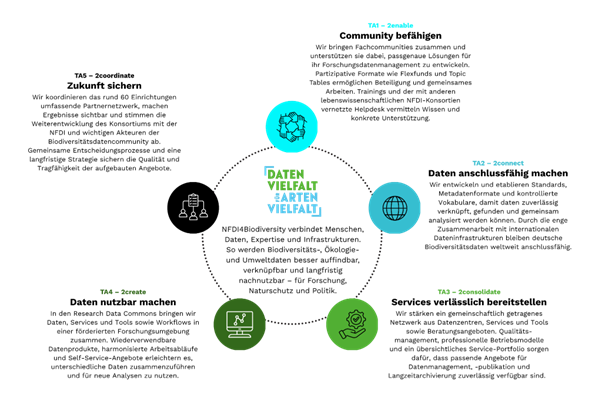
NFDI4Biodiversity’s work is organised into five Task Areas (TAs). These bring together experts from different institutions to address the consortium’s core responsibilities.
Empowering the community (TA1 – 2enable)
NFDI4Biodiversity brings specialist communities together and helps them develop solutions tailored to their research data management needs. Topic Tables, Flexfunds and other opportunities for participation allow community members to raise specific needs and develop solutions collaboratively. Training, helpdesk services and guidance on legal issues provide knowledge and practical support. Working with partners from research, society and policymaking, the consortium also develops new data pipelines and mobilises, harmonises and raises the visibility of openly available species observation data.
Connecting data (TA2 – 2connect)
NFDI4Biodiversity develops and establishes data and metadata standards, controlled vocabularies and methods for semantic annotation. These make biodiversity data easier to find, reliably linkable and usable across disciplines and systems. Close collaboration with national and international biodiversity infrastructures ensures that German data resources remain interoperable worldwide and that relevant international services are reliably integrated into the research infrastructure.
Delivering reliable services (TA3 – 2consolidate)
NFDI4Biodiversity strengthens a collaborative network of data centres, tools and advisory services. It supports service providers in the professional development, operation and quality assurance of their services. A clearly structured service portfolio makes it easier to find suitable tools for data management, publication and long-term preservation. The consortium also continues to develop the GFBio data centre network and strengthen collaboration among local data managers, curators and data stewards.
Making data ready for research (TA4 – 2create)
Through the Research Data Commons (RDC), NFDI4Biodiversity brings data, tools and workflows together in a shared, federated research environment. Reusable data products, harmonised workflows and self-service resources make it easier to combine heterogeneous data and use them in new analyses. The aim is to lower technical and organisational barriers to making data available and reusing them, allowing researchers to focus more on generating new insights.
Securing our future together (TA5 – 2coordinate)
NFDI4Biodiversity coordinates its network of around 60 partner institutions, shares its results within and beyond the consortium, and works closely with the NFDI and key national and international partners to guide its further development. Transparent decision-making and shared governance ensure the quality and strategic direction of its work. At the same time, the consortium develops long-term plans for its services, infrastructure and the professional staff who keep services running, provide advice and enable collaboration across the network.

Prof. Dr. Frank Oliver Glöckner
Speaker of the consortium
(Co-)applicant institutions and (co-)speakers:
(Mit-)Antragstellende Institutionen und (Co-)Sprecher:innen:
- Zentrum für Marine Umweltwissenschaften (MARUM), Universität Bremen — MARUM – Center for Marine Environmental Sciences, University of Bremen — Frank Oliver Glöckner
- Botanischer Garten und Botanisches Museum Berlin (BGBM), Freie Universität Berlin — Botanic Garden and Botanical Museum Berlin (BGBM), Freie Universität Berlin — Anton Güntsch
- Friedrich-Schiller-Universität Jena (FSU) — Friedrich Schiller University Jena (FSU) — Birgitta König-Ries; Aletta Bonn
- Gesellschaft für Biologische Daten e.V. (GFBio e.V.) — German Federation for Biological Data (GFBio e.V.) — Barbara Ebert
- Gesellschaft für wissenschaftliche Datenverarbeitung mbH Göttingen (GWDG) — IT Service and Research Centre Göttingen (GWDG) — Ramin Yahyapour
- Justus-Liebig-Universität Gießen (JLU) — Justus Liebig University Giessen (JLU) — Alexander Goesmann
- Leibniz-Institut DSMZ – Deutsche Sammlung von Mikroorganismen und Zellkulturen GmbH (DSMZ) — Leibniz Institute DSMZ – German Collection of Microorganisms and Cell Cultures (DSMZ) — Lorenz Reimer
- Leibniz-Institut für Pflanzengenetik und Kulturpflanzenforschung (IPK) — Leibniz Institute of Plant Genetics and Crop Plant Research (IPK) — Uwe Scholz
- Philipps-Universität Marburg (UMR) — Marburg University (UMR) — Ortrun Brand
- Staatliche Naturwissenschaftliche Sammlungen Bayerns (SNSB) — Bavarian State Collections of Natural History (SNSB) — Stefan Seifert
- Institut für Bioinformatik-Infrastruktur (BIBI), Universität Bielefeld — Bielefeld Institute for Bioinformatics Infrastructure (BIBI), Bielefeld University — Jens Stoye
- Universität Kassel — University of Kassel — Birgit Gemeinholzer

MARUM – Center for Marine Environmental Sciences, University of Bremen
Applicant institution
Participating Institutions
- Alfred-Wegener-Institut, Helmholtz-Zentrum für Polar- und Meeresforschung (AWI) — Alfred Wegener Institute, Helmholtz Centre for Polar and Marine Research (AWI) — Janine Felden
- Arachnologische Gesellschaft e.V. (AraGes) — Arachnologische Gesellschaft e.V. (AraGes; offizieller Eigenname auch im englischen Auftritt) — Hubert Höfer
- Nationales Monitoringzentrum zur Biodiversität (NMZB) — National Monitoring Centre for Biodiversity (NMZB) — Tina Astor; David Eichenberg
- Dachverband Deutscher Avifaunisten e.V. (DDA) — Federation of German Avifaunists (DDA) — Jakob Katzenberger
- Deutsches Netzwerk für Bioinformatik-Infrastruktur e.V. (de.NBI e.V.) — German Network for Bioinformatics Infrastructure e.V. (de.NBI e.V.) — Sina-Victoria Barysch
- Deutsches Zentrum für integrative Biodiversitätsforschung (iDiv) — German Centre for Integrative Biodiversity Research (iDiv) — Henrique Pereira
- Rote-Liste-Zentrum (RLZ), Deutsches Zentrum für Luft- und Raumfahrt e.V. (DLR) — Red List Centre (RLZ), German Aerospace Center (DLR) — Steffen Caspari
- Forschungsinstitut für Nutztierbiologie (FBN) — Research Institute for Farm Animal Biology (FBN) — Klaus Wimmers
- Generaldirektion der Staatlichen Archive Bayerns (GDA) — General Directorate of the Bavarian State Archives (GDA) — Bernhard Grau
- Niedersächsische Staats- und Universitätsbibliothek Göttingen (SUB), Georg-August-Universität Göttingen — Göttingen State and University Library (SUB), University of Göttingen — Daniel Kurzawe
- Gesellschaft deutschsprachiger Odonatologen e.V. (GdO) — Society of German-Speaking Odonatologists (GdO) — Claus-Jürgen Conze
- Gesellschaft für Ichthyologie e.V. (GfI) — German Ichthyological Society (GfI) — Fabian Herder
- Gesellschaft für Ökologie e.V. (GfÖ) — Ecological Society of Germany, Austria and Switzerland (GfÖ) — Christian Ammer
- Fachinformationsdienst Biodiversitätsforschung (BIOfid), Johann Wolfgang Goethe-Universität Frankfurt am Main — Biodiversity Research Information Service (BIOfid), Goethe University Frankfurt — Gerwin Kasperek
- Heidelberger Institut für Theoretische Studien gGmbH (HITS) — Heidelberg Institute for Theoretical Studies (HITS) — Wolfgang Müller
- Helmholtz-Zentrum für Umweltforschung (UFZ) — Helmholtz Centre for Environmental Research – UFZ — Alexander Harpke
- Hessisches Landesamt für Naturschutz, Umwelt und Geologie (HLNUG) — Hessian Agency for Nature Conservation, Environment and Geology (HLNUG) — Stephan Karger
- Institut für Angewandte Informatik (InfAI) — Institute for Applied Informatics (InfAI) — Adrian Paschke
- Julius Kühn-Institut (JKI), Bundesforschungsinstitut für Kulturpflanzen — Julius Kühn Institute (JKI), Federal Research Centre for Cultivated Plants — Holger Beer
- Landesamt für Umweltschutz Sachsen-Anhalt (LAU) — Saxony-Anhalt State Office for Environmental Protection (LAU) — Sandra Hagel; Marcel Seyring
- Leibniz-Institut für Gewässerökologie und Binnenfischerei (IGB) — Leibniz Institute of Freshwater Ecology and Inland Fisheries (IGB) — Hans-Peter Grossart
- Leibniz-Institut für Länderkunde (IfL) — Leibniz Institute for Regional Geography (IfL) — Jana Moser
- Leibniz-Institut für ökologische Raumentwicklung (IÖR) — Leibniz Institute of Ecological Urban and Regional Development (IÖR) — Ralf-Uwe Syrbe
- Leibniz-Institut für Ostseeforschung Warnemünde (IOW) — Leibniz Institute for Baltic Sea Research Warnemünde (IOW) — Oliver Zielinski
- Leibniz-Institut zur Analyse des Biodiversitätswandels (LIB) — Leibniz Institute for the Analysis of Biodiversity Change (LIB) — Peter Grobe
- Leibniz-Zentrum für Marine Tropenforschung (ZMT) — Leibniz Centre for Tropical Marine Research (ZMT) — Nicolas Dittert
- Max-Planck-Institut für Biogeochemie (MPI-BGC) — Max Planck Institute for Biogeochemistry (MPI-BGC) — Jens Kattge
- Museum für Naturkunde – Leibniz-Institut für Evolutions- und Biodiversitätsforschung (MfN) — Museum für Naturkunde – Leibniz Institute for Evolution and Biodiversity Science (MfN) — Mareike Petersen
- NABU|naturgucker.de gemeinnützige eG — NABU|naturgucker.de non-profit cooperative — Stefan Munzinger
- Netzwerk Phytodiversität Deutschland e.V. (NetPhyD) — Network Phytodiversity Germany e.V. (NetPhyD) — Florian Jansen
- Niedersächsischer Landesbetrieb für Wasserwirtschaft, Küsten- und Naturschutz (NLWKN) — Lower Saxony Water Management, Coastal Defence and Nature Conservation Agency (NLWKN) — Jakob Fahr
- Rheinisch-Westfälische Technische Hochschule Aachen (RWTH Aachen) — RWTH Aachen University — Alexander Bach
- Rheinland-Pfälzische Technische Universität Kaiserslautern-Landau (RPTU) — RPTU University Kaiserslautern-Landau — Timo Mühlhaus
- Senatsverwaltung für Mobilität, Verkehr, Klimaschutz und Umwelt (SenMVKU) — Berlin Senate Department for Mobility, Transport, Climate Action and the Environment — Stefanie Hennecke; Camillo Kitzmann
- Senckenberg Gesellschaft für Naturforschung (SGN) — Senckenberg Society for Nature Research (SGN) — Hanieh Saeedi
- Staatliches Museum für Naturkunde Karlsruhe (SMNK) — State Museum of Natural History Karlsruhe (SMNK) — Hubert Höfer
- Staatliches Museum für Naturkunde Stuttgart (SMNS) — State Museum of Natural History Stuttgart (SMNS) — Joachim Holstein
- Nationales Zentrum für Umwelt- und Naturschutzinformationen am Umweltbundesamt (UBA) — National Centre for Environmental and Nature Conservation Information at the German Environment Agency (UBA) — Anja Reineke
- Unabhängiges Institut für Umweltfragen e.V. (UfU) — Independent Institute for Environmental Issues (UfU) — Tom Grünberger; Michael Zschiesche
- Aquatische Ökosystemforschung, Universität Duisburg-Essen (UDE) — Aquatic Ecosystem Research, University of Duisburg-Essen (UDE) — Florian Leese
- Universität Leipzig — Leipzig University — Miguel Dario Mahecha; Christian Wirth
- Zentrum für integrative Biodiversitätsforschung und angewandte Ökologie (CIBRA), Universität Münster — Centre for Integrative Biodiversity Research and Applied Ecology (CIBRA), University of Münster — Sascha Buchholz
- Universität Passau — University of Passau — Malte Rehbein
Prof. Dr Frank Oliver Glöckner
Speaker of the consortium
MARUM – Center for Marine Environmental Sciences
University of Bremen
Applicant institution
(Co-)applicant institutions and (co-)speakers:
- Zentrum für Marine Umweltwissenschaften (MARUM), Universität Bremen — MARUM – Center for Marine Environmental Sciences, University of Bremen — Frank Oliver Glöckner
- Botanischer Garten und Botanisches Museum Berlin (BGBM), Freie Universität Berlin — Botanic Garden and Botanical Museum Berlin (BGBM), Freie Universität Berlin — Anton Güntsch
- Friedrich-Schiller-Universität Jena (FSU) — Friedrich Schiller University Jena (FSU) — Birgitta König-Ries; Aletta Bonn
- Gesellschaft für Biologische Daten e.V. (GFBio e.V.) — German Federation for Biological Data (GFBio e.V.) — Barbara Ebert
- Gesellschaft für wissenschaftliche Datenverarbeitung mbH Göttingen (GWDG) — IT Service and Research Centre Göttingen (GWDG) — Ramin Yahyapour
- Justus-Liebig-Universität Gießen (JLU) — Justus Liebig University Giessen (JLU) — Alexander Goesmann
- Leibniz-Institut DSMZ – Deutsche Sammlung von Mikroorganismen und Zellkulturen GmbH (DSMZ) — Leibniz Institute DSMZ – German Collection of Microorganisms and Cell Cultures (DSMZ) — Lorenz Reimer
- Leibniz-Institut für Pflanzengenetik und Kulturpflanzenforschung (IPK) — Leibniz Institute of Plant Genetics and Crop Plant Research (IPK) — Uwe Scholz
- Philipps-Universität Marburg (UMR) — Marburg University (UMR) — Ortrun Brand
- Staatliche Naturwissenschaftliche Sammlungen Bayerns (SNSB) — Bavarian State Collections of Natural History (SNSB) — Stefan Seifert
- Institut für Bioinformatik-Infrastruktur (BIBI), Universität Bielefeld — Bielefeld Institute for Bioinformatics Infrastructure (BIBI), Bielefeld University — Jens Stoye
- Universität Kassel — University of Kassel — Birgit Gemeinholzer
Participating Institutions
- Alfred-Wegener-Institut, Helmholtz-Zentrum für Polar- und Meeresforschung (AWI) — Alfred Wegener Institute, Helmholtz Centre for Polar and Marine Research (AWI) — Janine Felden
- Arachnologische Gesellschaft e.V. (AraGes) — Arachnologische Gesellschaft e.V. (AraGes; offizieller Eigenname auch im englischen Auftritt) — Hubert Höfer
- Nationales Monitoringzentrum zur Biodiversität (NMZB) — National Monitoring Centre for Biodiversity (NMZB) — Tina Astor; David Eichenberg
- Dachverband Deutscher Avifaunisten e.V. (DDA) — Federation of German Avifaunists (DDA) — Jakob Katzenberger
- Deutsches Netzwerk für Bioinformatik-Infrastruktur e.V. (de.NBI e.V.) — German Network for Bioinformatics Infrastructure e.V. (de.NBI e.V.) — Sina-Victoria Barysch
- Deutsches Zentrum für integrative Biodiversitätsforschung (iDiv) — German Centre for Integrative Biodiversity Research (iDiv) — Henrique Pereira
- Rote-Liste-Zentrum (RLZ), Deutsches Zentrum für Luft- und Raumfahrt e.V. (DLR) — Red List Centre (RLZ), German Aerospace Center (DLR) — Steffen Caspari
- Forschungsinstitut für Nutztierbiologie (FBN) — Research Institute for Farm Animal Biology (FBN) — Klaus Wimmers
- Generaldirektion der Staatlichen Archive Bayerns (GDA) — General Directorate of the Bavarian State Archives (GDA) — Bernhard Grau
- Niedersächsische Staats- und Universitätsbibliothek Göttingen (SUB), Georg-August-Universität Göttingen — Göttingen State and University Library (SUB), University of Göttingen — Daniel Kurzawe
- Gesellschaft deutschsprachiger Odonatologen e.V. (GdO) — Society of German-Speaking Odonatologists (GdO) — Claus-Jürgen Conze
- Gesellschaft für Ichthyologie e.V. (GfI) — German Ichthyological Society (GfI) — Fabian Herder
- Gesellschaft für Ökologie e.V. (GfÖ) — Ecological Society of Germany, Austria and Switzerland (GfÖ) — Christian Ammer
- Fachinformationsdienst Biodiversitätsforschung (BIOfid), Johann Wolfgang Goethe-Universität Frankfurt am Main — Biodiversity Research Information Service (BIOfid), Goethe University Frankfurt — Gerwin Kasperek
- Heidelberger Institut für Theoretische Studien gGmbH (HITS) — Heidelberg Institute for Theoretical Studies (HITS) — Wolfgang Müller
- Helmholtz-Zentrum für Umweltforschung (UFZ) — Helmholtz Centre for Environmental Research – UFZ — Alexander Harpke
- Hessisches Landesamt für Naturschutz, Umwelt und Geologie (HLNUG) — Hessian Agency for Nature Conservation, Environment and Geology (HLNUG) — Stephan Karger
- Institut für Angewandte Informatik (InfAI) — Institute for Applied Informatics (InfAI) — Adrian Paschke
- Julius Kühn-Institut (JKI), Bundesforschungsinstitut für Kulturpflanzen — Julius Kühn Institute (JKI), Federal Research Centre for Cultivated Plants — Holger Beer
- Landesamt für Umweltschutz Sachsen-Anhalt (LAU) — Saxony-Anhalt State Office for Environmental Protection (LAU) — Sandra Hagel; Marcel Seyring
- Leibniz-Institut für Gewässerökologie und Binnenfischerei (IGB) — Leibniz Institute of Freshwater Ecology and Inland Fisheries (IGB) — Hans-Peter Grossart
- Leibniz-Institut für Länderkunde (IfL) — Leibniz Institute for Regional Geography (IfL) — Jana Moser
- Leibniz-Institut für ökologische Raumentwicklung (IÖR) — Leibniz Institute of Ecological Urban and Regional Development (IÖR) — Ralf-Uwe Syrbe
- Leibniz-Institut für Ostseeforschung Warnemünde (IOW) — Leibniz Institute for Baltic Sea Research Warnemünde (IOW) — Oliver Zielinski
- Leibniz-Institut zur Analyse des Biodiversitätswandels (LIB) — Leibniz Institute for the Analysis of Biodiversity Change (LIB) — Peter Grobe
- Leibniz-Zentrum für Marine Tropenforschung (ZMT) — Leibniz Centre for Tropical Marine Research (ZMT) — Nicolas Dittert
- Max-Planck-Institut für Biogeochemie (MPI-BGC) — Max Planck Institute for Biogeochemistry (MPI-BGC) — Jens Kattge
- Museum für Naturkunde – Leibniz-Institut für Evolutions- und Biodiversitätsforschung (MfN) — Museum für Naturkunde – Leibniz Institute for Evolution and Biodiversity Science (MfN) — Mareike Petersen
- NABU|naturgucker.de gemeinnützige eG — NABU|naturgucker.de non-profit cooperative — Stefan Munzinger
- Netzwerk Phytodiversität Deutschland e.V. (NetPhyD) — Network Phytodiversity Germany e.V. (NetPhyD) — Florian Jansen
- Niedersächsischer Landesbetrieb für Wasserwirtschaft, Küsten- und Naturschutz (NLWKN) — Lower Saxony Water Management, Coastal Defence and Nature Conservation Agency (NLWKN) — Jakob Fahr
- Rheinisch-Westfälische Technische Hochschule Aachen (RWTH Aachen) — RWTH Aachen University — Alexander Bach
- Rheinland-Pfälzische Technische Universität Kaiserslautern-Landau (RPTU) — RPTU University Kaiserslautern-Landau — Timo Mühlhaus
- Senatsverwaltung für Mobilität, Verkehr, Klimaschutz und Umwelt (SenMVKU) — Berlin Senate Department for Mobility, Transport, Climate Action and the Environment — Stefanie Hennecke; Camillo Kitzmann
- Senckenberg Gesellschaft für Naturforschung (SGN) — Senckenberg Society for Nature Research (SGN) — Hanieh Saeedi
- Staatliches Museum für Naturkunde Karlsruhe (SMNK) — State Museum of Natural History Karlsruhe (SMNK) — Hubert Höfer
- Staatliches Museum für Naturkunde Stuttgart (SMNS) — State Museum of Natural History Stuttgart (SMNS) — Joachim Holstein
- Nationales Zentrum für Umwelt- und Naturschutzinformationen am Umweltbundesamt (UBA) — National Centre for Environmental and Nature Conservation Information at the German Environment Agency (UBA) — Anja Reineke
- Unabhängiges Institut für Umweltfragen e.V. (UfU) — Independent Institute for Environmental Issues (UfU) — Tom Grünberger; Michael Zschiesche
- Aquatische Ökosystemforschung, Universität Duisburg-Essen (UDE) — Aquatic Ecosystem Research, University of Duisburg-Essen (UDE) — Florian Leese
- Universität Leipzig — Leipzig University — Miguel Dario Mahecha; Christian Wirth
- Zentrum für integrative Biodiversitätsforschung und angewandte Ökologie (CIBRA), Universität Münster — Centre for Integrative Biodiversity Research and Applied Ecology (CIBRA), University of Münster — Sascha Buchholz
- Universität Passau — University of Passau — Malte Rehbein