
About us
Engineering sciences play a key role in developing solutions to the technical, ecological, and economic challenges of modern societies. To ensure that research processes and their results are sustainable, they require professional research data management (RDM) that implements the FAIR principles: data must be findable, accessible, interoperable, and reusable.
The NFDI4ING consortium brings together the diverse research areas of the engineering sciences and develops, standardizes, and disseminates methods, services, and tools that facilitate working with complex research data. Since 2017, NFDI4ING has been collaborating with researchers, research data managers, infrastructure providers, and partners from industry and policy to strengthen the exchange of data and knowledge and to make research processes more transparent and efficient.
Goals
- Strengthening and connecting the engineering research community by building long-term structures for communication, training and support, operating a central helpdesk and fostering open Special Interest Groups.
- Providing scalable and accessible RDM solutions by developing integrated, sustainable services with clear entry points and by continuously assessing the needs of the engineering community.
- Standardising and automating RDM processes by implementing FAIR Digital Objects, establishing a Common Information Model, building federated knowledge graphs and offering an RDM Copilot as central support.
- Ensuring that research data in engineering is FAIR and AI-ready by 2030 by making data and software machine-actionable and integrating AI throughout the data lifecycle.
- Promoting a sustainable research data culture by supporting RDM education, improving scientific credit through FAIR practices, collaborating with industry and standards bodies and contributing to the long-term vision of OneNFDI.
Task Area
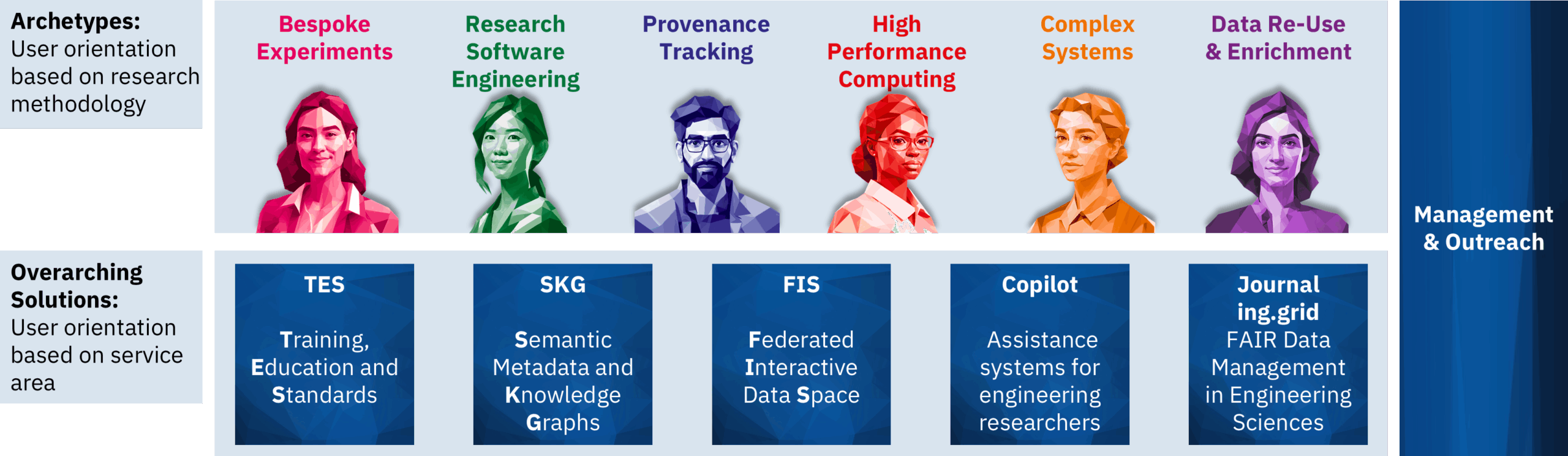
The NFDI4ING work programme is organised into three complementary groups of task areas:
- Archetype Task Areas – addressing research-data management challenges and methods specific to typical engineering workflows.
- Overarching Solutions Task Areas – providing cross-cutting infrastructure, standards, services and support usable by all archetypes, and bridging to the wider NFDI ecosystem (e.g. via Base4NFDI).
- Management & Outreach Task Area – coordinating consortium-wide communication, outreach, community participation, quality assurance, and ensuring long-term sustainability of services.
The NFDI4ING Archetypes:
NFDI4ING’s “archetype” concept clusters typical engineering research workflows into a small number of representative profiles – so-called “archetypes” – to capture recurring needs, methods, and challenges in research data management (RDM).
Based on this classification, NFDI4ING develops tailored services and solutions addressing data handling in engineering workflows (e.g., experiments, simulations, sample tracking, heterogeneous data, field data). A validation via focus groups and a large survey showed that 95% of responding research groups identify with at least one archetype (many mix features of several), demonstrating the concept’s broad relevance across engineering disciplines.
The Archetypes and their key challenges in short:
- ALEX: tailored experiments whose setups often change, requiring flexible data-management strategies.
- BETTY: research driven by software tools, simulations, or code, where data is largely generated/managed via software.
- CADEN: workflows that require tracing of physical samples or data through many processing stages.
- DORIS: simulations or measurements using High-Performance Computing, producing large datasets needing special storage, metadata and reproducibility solutions.
- ELLEN: research combining many different data types/sources, i.e. integrating data from literature, sensors, experiments, etc.
- FIONA: building on existing, often distributed and heterogeneous datasets: re-uses, combines, and enriches data from multiple sources, making it available to other researchers and machines.
The Overarching Solutions:
NFDI4ING’s “Overarching Solutions” are cross-cutting service areas that provide infrastructure, standards, and support for all engineering research workflows. They offer shared base services such as quality assurance, research-software support, metadata and terminology management, repositories, data security, training, and data/knowledge discovery. By harmonising and scaling these services, NFDI4ING prevents siloed approaches and enables consistent, FAIR- and AI-ready data handling across communities. They also ensure integration with national and international infrastructures, supporting federated identity and access, common information models, and long-term sustainability.
The Overarching Solutions and their key challenges in short:
- TES – Training, Education & Standardisation: Provides standardised RDM training for engineering sciences, integrates RDM into university teaching, and drives standardisation via NFDI-RFCs.
- SKG – Semantic Metadata & Knowledge Graphs: Develops harmonised metadata models for FAIR Digital Objects and enables federated use of engineering knowledge graphs.
- FIS – Federated Interactive Data Space: Provides information services to search and find data, interactive federated services to store and share data across infrastructures.
- CPT – Copilot: Assistance Systems & AI: Creates AI-based assistance for RDM processes, including formal data-quality assessment, chatbots and recommender systems, and AI support for research-software engineers.
- J – Journal ing.grid: Ensures efficient operation of the Open-Access engineering RDM journal ing.grid and supports community-building and outreach.
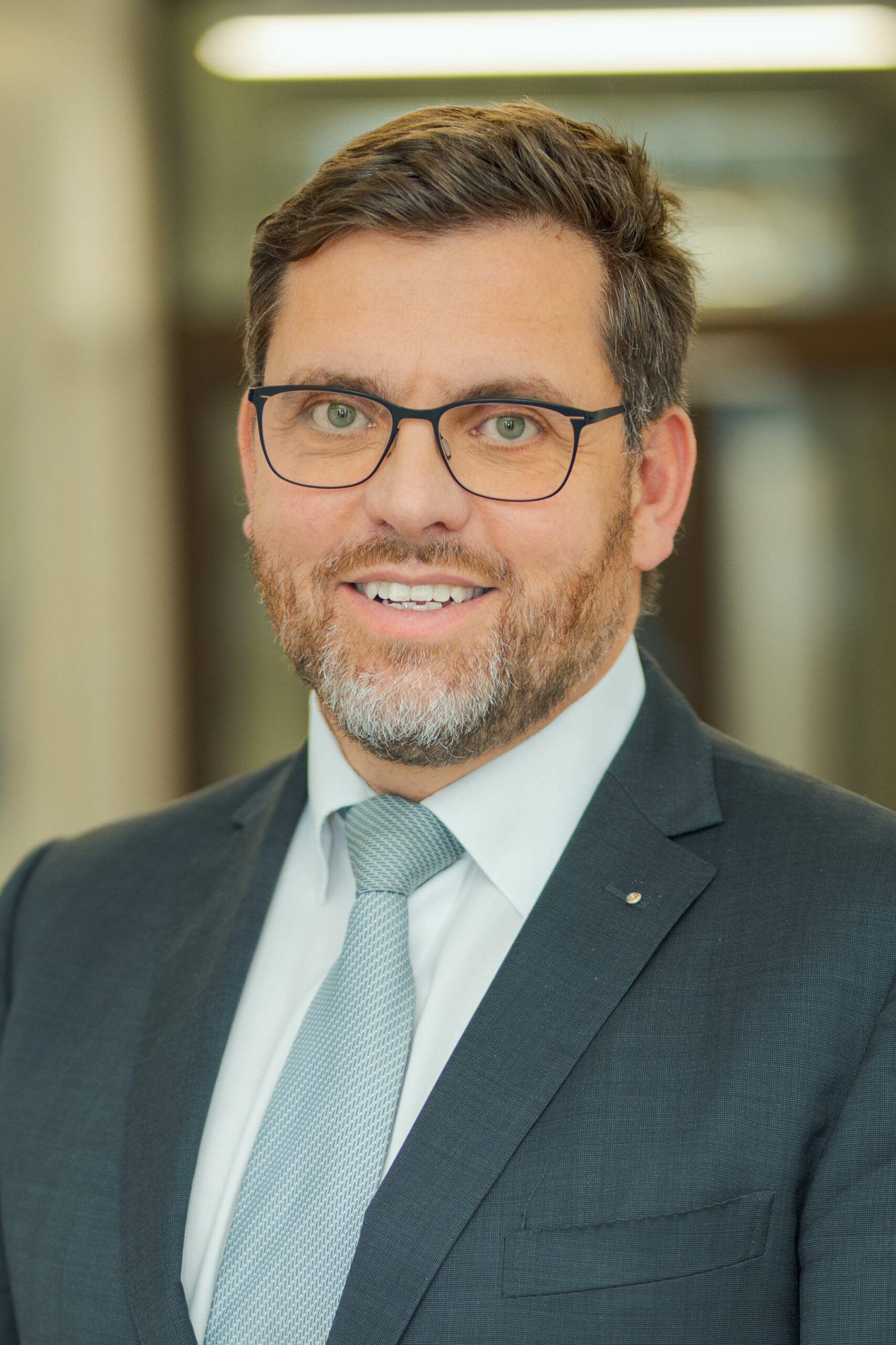
Prof. Dr. Peter Pelz
Speaker of the consortium
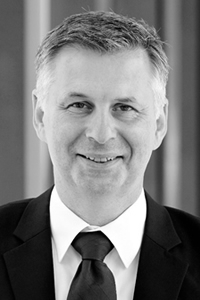
Prof. Dr. Robert Schmitt
Speaker of the consortium
TU Darmstadt
Applicant institution
(Co-)applicant institutions and (co-)speakers:
Co-Applicants of the second funding round:
- Bundesanstalt für Materialforschung und -prüfung (BAM) Berlin
- Deutsches Zentrum für Luft- und Raumfahrt (DLR) Köln
- Forschungszentrum Jülich (FZJ) Jülich
- Karlsruher Institut für Technologie (KIT) Karlsruhe
- Leibniz-Universität Hannover (LUH) Hannover
- Rheinisch-Westfälische Technische Hochschule Aachen (RWTH) Aachen
- TIB – Leibniz-Informationszentrum Technik und Naturwissenschaften und Universitätsbibliothek Hannover
- Technische Universität Braunschweig (TUBS) Braunschweig
- Technische Universität Clausthal (TUC) Clausthal-Zellerfeld
- Technische Universität München (TUM) München
- Universität Stuttgart (US) Stuttgart
Co-Spokespersons of the second funding round:
- Auer, Sören
- Beetz, Jakob
- Bronger, Torsten
- Dreizler, Andreas
- Flemisch, Bernd
- Iglezakis, Dorothea
- Jagusch, Gerald
- Kuckertz, Patrick
- Lachmayer, Roland
- Langenbach, Christian
- Linxweiler, Jan
- Müller, Matthias
- Nestler, Britta
- Pelz, Peter
- Politze, Marius
- Schmitt, Robert H.
- Schwarz, Annett
- Selzer, Michael
- Sens, Irina
- Stäcker, Thomas
- Stemmer, Christian
- Streit, Achim
- Unger, Jörg F.
- Wittek, Stefan
Participating institutions
Participating Institutions of the second funding round:
- Access e.V.
- Bayerische Akademie der Wissenschaften (Leibniz-Rechenzentrum)
- DataCite e.V.
- DARL e.V.
- Verein zur Förderung eines Deutschen Forschungsnetzes (DFN)
- Fraunhofer Institut für Produktionstechnologie (IPT)
- Gesellschaft für wissenschaftliche Datenverarbeitung mbH (GWDG)
- Helmholtz-Zentrum hereon
- Hochschule Darmstadt (h_da)
- Hochschule Fulda (HF)
- Hochschule für Technik Stuttgart (HFT)
- Hochschule Karlsruhe (HK)
- Hochschule RheinMain (HSRM)
- Leibniz-Institut für Plasmaforschung und Technologie (INP)
- Physikalisch-technische Bundesanstalt (PTB)
- Ruhr-Universität Bochum (RUB)
- Sächsische Landesbibliothek – Staats- und Universitätsbibliothek Dresden
- Technische Hochschule Köln (TH K)
- Technische Hochschule Mittelhessen (THM)
- Technische Hochschule Wildau
- Technische Universität Berlin
- Technische Universität Chemnitz
- Technische Universität Hamburg
- Universität Freiburg
- Universität Paderborn
Participating Individuals of the second funding round:
- Atakan, Burak – Universität Duisburg-Essen
- Begoin, Mathias – TIB, FID Move, FID Materials Science
- Brand, Ortrun – Philipps-Universität Marburg, HeFDI
- Brümmer, Andreas – TU Dortmund
- Cyra, Magdalene – Universität Duisburg-Essen, FDM.NRW
- Fasoulas, Stefanos – Universität Stuttgart, CRC 1667 ATLAS
- Fimmers, Christian – RWTH Aachen, EXC Internet of Production
- Garcke, Harald – Universität Regensburg
- Gerlach, Roman – Friedrich-Schiller-Universität Jena, TKFDM
- Hartmaier, Alexander – Ruhr-Universität Bochum
- Hezel, Dominik – Goethe-Universität Frankfurt a. M.
- Johannsen, Jochen – RWTH Aachen, University Library
- Jung, Anne – Helmut-Schmidt-Universität
- Kirchner, Frank – Deutsches Forschungszentrum für Künstliche Intelligenz (DFKI)
- Kleinert, Sven – Leibniz-Universität Hannover, EXC PhoenixD
- König, Markus – Ruhr-Universität Bochum
- Köstler, Harald – FAU Erlangen-Nürnberg, NHR Erlangen
- Kübel, Christian – KIT
- Langer, Sabine C. – Universität Braunschweig, SFB/TRR 364 SynTrac
- Lanza, Gisela – KIT
- Maric, Tomislav – TU Darmstadt
- Marx, Steffen – TU Dresden
- Rehwald, Stephanie – Universität Duisburg-Essen, SFB/TRR 196 MARIE
- Schaaf, Peter – TU Ilmenau
- Schlenz, Hartmut – Forschungszentrum Jülich
- Schmidt, Michael – FAU Erlangen-Nürnberg, NHR Erlangen
- Weiskopf, Daniel – Universität Stuttgart, EXC IntCDC
- Wortmann, Thomas – Universität Stuttgart, EXC IntCDC
- Xu, Bai-Xang – TU Darmstadt