About us
NFDI4Cat focuses on catalysis research and catalysis-related sciences such as chemical engineering and process engineering. Catalysis is a highly complex and interdisciplinary field of science that enables the efficient production of a wide range of products for various industries and at different production scales. For catalysis as an interdisciplinary science with a strong application focus, NFDI4Cat offers the opportunity to integrate all sub-disciplines with regard to data management and data exchange, and to generate the highest possible added value. The need for a common approach is described in the GeCatS publication “The Digitalization of Catalysis-Related Sciences.”
The NFDI4Cat consortium consists of 14 experienced partners from all areas of catalysis and is coordinated by DECHEMA e.V. The disciplines of reaction engineering and process engineering are also represented within the consortium.
The catalysis and engineering expertise is complemented by knowledge in the areas of data science, high-performance computing, and machine learning. The consortium is additionally supported by an advisory expert panel. This panel is composed of dedicated representatives from major German companies that are active in the field of catalysis. The consortium brings together a broad range of existing know-how, hardware, repositories, and software tools that can be built upon to ensure targeted, efficient, and cross-disciplinary work.
Goals
The central goal of NFDI4Cat is to promote and support cross-disciplinary research in the field of catalysis in order to realise the vision “from molecule to process” on a digital level. The NFDI4Cat infrastructure aims to build a bridge between the different expert communities and between industry and academia. In order to achieve broad acceptance of the NFDI, NFDI4Cat also addresses key issues of intellectual property, access rights, and incentive systems.
Task Area
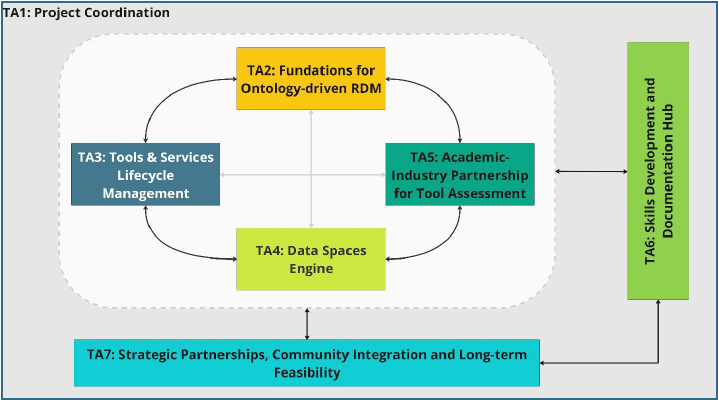
The experts in the NFDI4Cat consortium have developed a work programme that is divided into eight task areas (TA1-8).
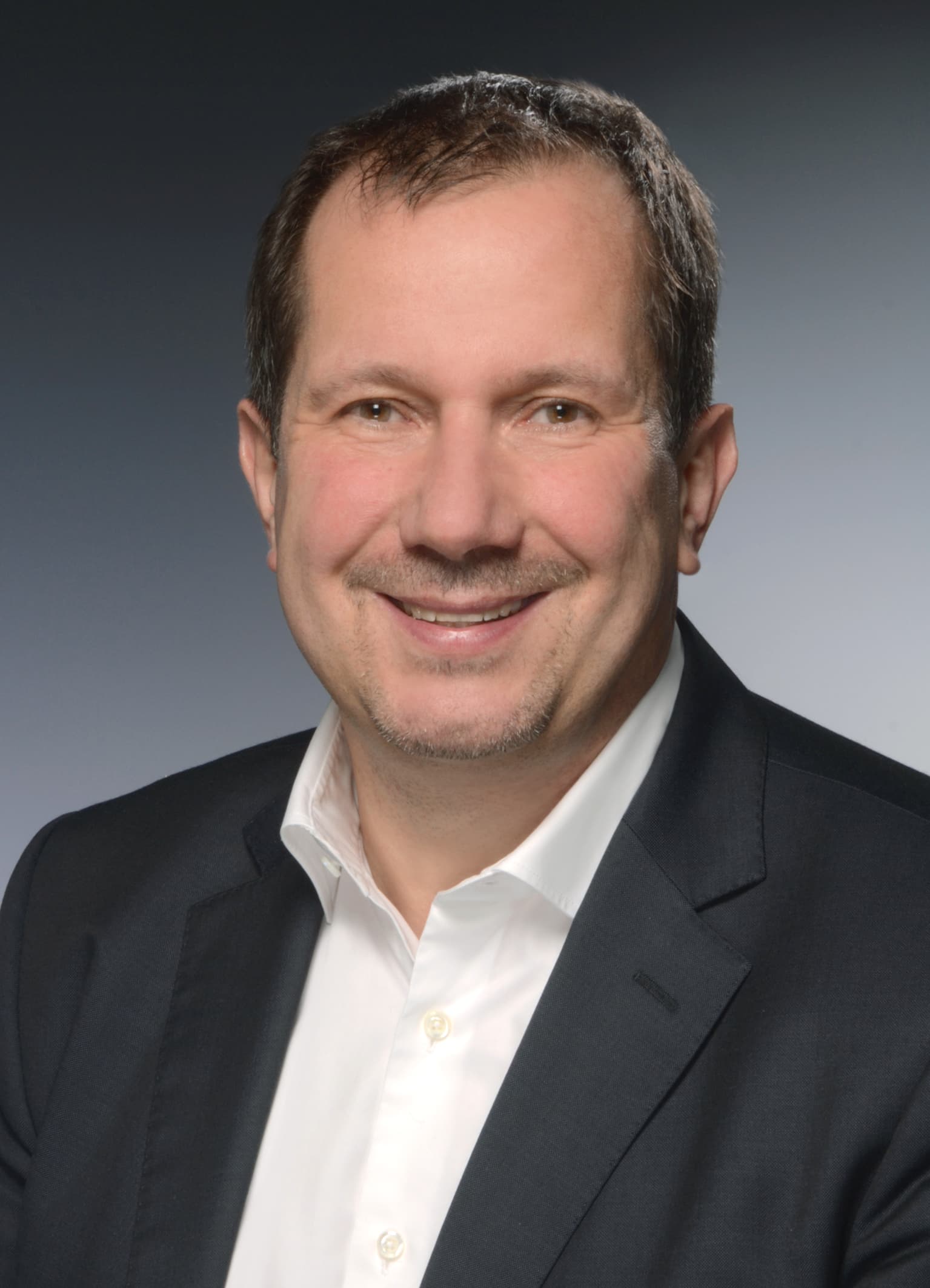
Dr. Andreas Förster
Speaker of the consortium
(Co-)applicant institutions and (co-)speakers:
- Prof. Dr. Matthias Beller – Leibniz-Institut für Katalyse
- Dr. Mark Dörr – Universität Greifswald
- Prof. Dr. Olaf Deutschmann – Karlsruhe Institut für Technology
- Dr. Andreas Förster – DECHEMA e.V.
- Prof. Dr. Roger Gläser – Universität Leipzig
- Prof. Dr. Richard Lenz – Friedrich-Alexander-Universität Erlangen-Nürnberg
- Prof. Dr. -Ing. Norbert Kockmann – TU Dortmund
- Prof. Dr. Udo Kragl – Universität Rostock
- Dr. Michael Geske – TU Berlin
- Prof. Dr. Regina Palkovits – RWTH Aachen
- Prof. Dr. Michael Resch – High Performance Computing Center Stuttgart (HLRS)
- Prof. Dr. Karsten Reuter – Fritz-Haber-Institut der Max-Planck-Gesellschaft
- Prof. Dr. Marcus Rose – Tu Darmstadt
- Prof. Dr. Sonja Schimmler – Fraunhofer FOKUS
DECHEMA Gesellschaft für Chemische Technik und Biotechnologie e.V.
Applicant institution
Participating Institutions
- Max-Planck-Institut für Chemische Energiekonversion – Participant
- Max Planck Institut für Dynamik Komplexer Technischer Systeme – Participant
- TU München – Participant
- Universität Bielefeld – Participant
- Universität Hamburg – Participant
- Universität Siegen – Participant
- Universität Ulm – Participant
- hte GmbH – Advisory Board
- BASF SE – Advisory Board
- Clariant Produkte GmbH – Advisory Board
- Covestro Deutschland AG – Advisory Board
- Evonik Industries AG – Advisory Board
- Linde AG – Advisory Board
- Thyssenkrupp Industrial Solutions AG – Advisory Board
- Bunsengesellschaft – Partnership
- DGMK – Partnership
- GDCh – Partnership
- GeCatS – Partnership
- ProcessNet – Partnership
- VDI – Partnership – Partnership
Dr. Andreas Förster
Speaker of the consortium
University of FreiburgFreiburg
Applicant Institution
(Co-)applicant institutions and (co-)speakers:
- Prof. Dr. Matthias Beller – Leibniz Institute for Catalysis
- Prof. Dr. Peter Benner – Max Planck Institute for Dynamics of Complex Technical Systems
- Prof. Dr. Uwe Bornscheuer – University of Greifswald
- Prof. Dr. Olaf Deutschmann – Karlsruhe Institute of Technology
- Prof. Dr. Roger Gläser – Leipzig University
- Dr. Marco Haumann – Friedrich-Alexander University Erlangen-Nürnberg
- Prof. Dr.-Ing. Norbert Kockmann – TU Dortmund University
- Prof. Dr. Udo Kragl – University of Rostock
- Dr.-Ing. habil. Ralph Krähnert – TU Berlin
- Prof. Dr. Walter Leitner – Max Planck Institute for Chemical Energy Conversion
- Prof. Dr. Johannes Lercher – Technical University of Munich
- Prof. Dr. Mehtap Oezaslan – TU Braunschweig
- Prof. Dr. Regina Palkovits – RWTH Aachen University
- Prof. Dr. Michael Resch – High-Performance Computing Center Stuttgart (HLRS)
- Prof. Dr. Sonja Schimmler – Fraunhofer FOKUS
- Prof. Dr. Kurt Wagemann – DECHEMA e.V.
Participating Institutions
- TU Darmstadt – Participant
- Forschungszentrum Juelich GmbH – Participant
- BIFOLD – Participant
- hte GmbH – Advisory Board
- Linde AG – Advisory Board
- Thyssenkrupp Industrial Solutions AG – Advisory Board
- Covestro Deutschland AG – Advisory Board
- Evonik Industries AG – Advisory Board
- Clariant Produkte GmbH – Advisory Board
- Bunsengesellschaft – Partnership
- VDI – Partnership – Partnership
- ProcessNet – Partnership
- GeCatS – Partnership
- DGMK – Partnership
- GDCh – Partnership
- NFDI4Chem – Partnership
- NFDI4Ing – Partnership
- DAPHNE – Partnership
- FAIRMat – Partnership