
About us
Plant research uses interdisciplinary approaches to understand the mechanisms of plant physiology, growth and productivity. High-throughput and targeted methods generate large amounts of data from genomics, transcriptomics, proteomics, and metabolomics, alongside increasingly complex imaging data and model simulations. To utilise this data effectively, research data management (RDM) according to the FAIR principles, data sharing and scientific collaboration are crucial. DataPLANT supports plant research through an open model that provides robust and accessible RDM practices and tools. A central element is the Annotated Research Context (ARC), which integrates relevant research data and metadata into FAIR-compliant digital objects. In addition, the PLANTdataHUB cloud platform facilitates data exchange, publication and collaborative data management.
DataPLANT is in its second funding period (October 2025 – September 2030). This amplification phase scales adoption of the tools and services established in the first period and embeds them in the national research infrastructure.
DataPLANT promotes the plant research data community through training activities and the provision of a data management plan wizard, as well as automated key performance tracking via Scorpion. The aim is broad, pan-regional participation across Germany within NFDI, focussing on interoperability and integration of existing datasets. DataPLANT also works with other NFDI consortia — particularly via the BioData Interest Group (with FAIRagro, NFDI4Biodiversity, NFDI4BIOIMAGE, NFDI4Microbiota and NFDI4Objects) — and aligns with Base4NFDI basic services such as identity and access management, persistent identifiers and terminology services, to develop common standards, shared helpdesks and best practices for data processing and quality control. Automation and community involvement ensure the sustainability of DataPLANT services and support the creation of high-quality data publications.
Goals
DataPLANT is data-centred and builds on existing structures. A fundamental element for achieving the goal is the Annotated Research Context (ARC), which acts as an entry point and defines the structure of a data publication compliant with international standards such as RO-Crate and ISA-Tab. The ARC covers the entire research cycle, from the experiment to the computational aspects to the actual data and metadata as well as the resulting publications. It builds on existing formats, terminologies and guidelines — including community-tailored checklists such as MIAPPE, made available to users through the Swate annotation tool — so that the integration of existing data into existing repositories can take place as smoothly as possible. A range of mature tools and services are available to ensure a quick start to improved data management early on. At the same time, the technical infrastructure for the shared use, versioning and automated broker submission (via MARS) of ARCs is fully operationalized across the PLANTdataHUB. Accordingly, DataPLANT is the central point of contact for researchers in fundamental plant research in RDM matters.
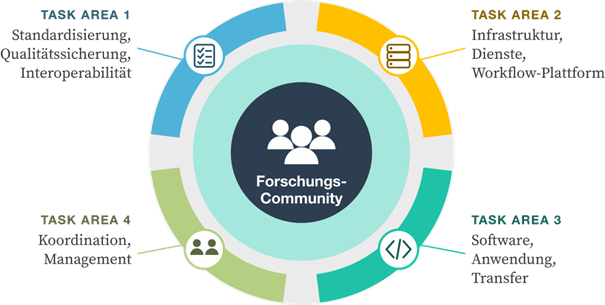
Task Areas
Dr. Dirk von Suchodoletz
Speaker of the consortium
(Co-)applicant institutions and (co-)speakers:
- Prof. Dr. Timo Mühlhaus – Rheinland-Pfälzische Technische Universität Kaiserslautern-Landau
- Dr. Uwe Scholz – Leibniz-Institut für Pflanzengenetik und Kulturpflanzenforschung (IPK)
- Prof. Dr. Björn Usadel – Forschungszentrum Jülich

University of Freiburg
Applicant institution
Participating Institutions
- Prof. Dr. Rolf Backofen – Bioinformatik, Albert-Ludwigs-Universität Freiburg
- Olaf Brandt – Leiter der IT-Abteilung, Universitätsbibliothek, Eberhard Karls Universität Tübingen
- Prof. Dr. Andrea Bräutigam – Computational Biology, Universität Bielefeld
- Dr. Dominik Brilhaus – CEPLAS Cluster of Excellence on Plant Sciences Heinrich-Heine-Universität Düsseldorf
- Dr. Magdalene Cyra – fdm.nrw, University Library, University of Duisburg-Essen
- Prof. Dr. Stefan Deßloch – Heterogene Informationssysteme, Rheinland-Pfälzische Technische Universität Kaiserslautern-Landau
- Dr. Barbara Ebert – Executive Secretary, Gesellschaft für Biologische Daten, GFBio e.V. Bremen
- Prof. Dr. Alisdair Fernie – Zentraler Metabolismus Max-Planck-Institut für molekulare Pflanzenphysiologie
- Prof. Dr. Christoph Garth – Wissenschaftliche Visualisierung, Rheinland-Pfälzische Technische Universität Kaiserslautern-Landau
- Dr. Björn Grüning – Bioinformatik Albert-Ludwigs-Universität Freiburg
- Prof. Dr. Eric Kemen – Interfaculty Institute of Microbiology and Infection Medicine & Center for Plant Molecular Biology, Eberhard Karls University Tübingen
- Oliver Kohl-Frey – Kommunikations-, Informations-, Medienzentrum (KIM) Universität Konstanz
- Prof. Dr. Maria von Korff Schmising – Heinrich-Heine-University Düsseldorf, Plant Genetics
- Prof. Dr. Ute Krämer – Molekulargenetik und Physiologie der Pflanzen Ruhr-Universität Bochum
- Dr. Jens Krüger – High Performance and Cloud Computing Group, IT Center, Eberhard Karls University Tübingen
- Matthias Landwehr – Kommunikations-, Informations-, Medienzentrum (KIM) Universität Konstanz
- Prof. Dr. Dario Leister – Biozentrum, Ludwig-Maximilians-Universität München (LMU)
- Prof. Dr. Heike Leitte – Visuelle Informationsanalyse, Rheinland-Pfälzische Technische Universität Kaiserslautern-Landau
- Prof. Dr. Michael Lenhard – Genetics, University of Potsdam
- Prof. Dr. Rosa Lozano-Durán – Center for Plant Molecular Biology, Eberhard Karls University Tübingen
- Prof. Dr. Klaus F.X. Mayer – Genomik und Systembiologie pflanzlicher Genome (PGSB) Helmholtz Zentrum München – Deutsches Forschungszentrum für Gesundheit und Umwelt
- Prof. Dr. Isabel Monte – Center for Plant Molecular Biology, Eberhard Karls University Tübingen
- PD Dr. Wolfgang Müller – HITS gGmbH, Scientific Databases and Visualization Group (SDBV)
- Prof. Dr. Thomas Nägele – Plant Evolutionary Cell Biology, Ludwig-Maximilians University of München
- Prof. Dr. Sven Nahnsen – Zentrum für Quantitative Biologie Eberhard Karls Universität Tübingen
- Prof. Dr. Marcel Quint – Institute of Agricultural and Nutritional Science, Martin Luther University Halle-Wittenberg
- Prof. Dr. Klaus Rechert – Verwaltungs- und Wirtschaftsinformatik Hochschule für öffentliche Verwaltung Kehl
- Prof. Dr. Ralf Reski – Pflanzenbiotechnologie Albert-Ludwigs-Universität Freiburg
- Prof. Dr. Andreas Richter – Plant metabolic Physiology, University of Rostock
- Dr. Inga Scheler – Regionales Hochschulrechenzentrum Kaiserslautern, Rheinland-Pfälzische Technische Universität Kaiserslautern-Landau
- Prof. Dr. Christian Schmitz-Linneweber – Molecular Genetics, Humboldt University of Berlin
- Prof. Dr. Waltraud Schulze – Systembiologie der Pflanze Universität Hohenheim
- Prof. Dr. Nadine Töpfer – Institute for Plant Sciences, University of Cologne
- Prof. Dr. Haim Treves – Plant Metabolism, University of Kaiserslautern-Landau
- Prof. Dr. Jan de Vries – Applied Bioinformatics, Georg-August University of Göttingen
- Prof. Dr. Thomas Walter – Rechenzentrum Eberhard Karls Universität Tübingen
- Prof. Dr. Andreas P.M. Weber – Biochemie der Pflanzen Heinrich Heine Universität Düsseldorf
- Prof. Dr. Stefanie Weidtkamp-Peters – Center for Advanced Imaging Heinrich-Heine-Universität Düsseldorf
- Prof. Dr. Felix Willmund – Molecular Plant Physiology, Philipps-University of Marburg
Dr. Dirk von Suchodoletz
Speaker of the consortium
University of Freiburg
Applicant institution
(Co-)applicant institutions and (co-)speakers:
- Prof. Dr. Timo Mühlhaus – Rheinland-Pfälzische Technische Universität Kaiserslautern-Landau
- Dr. Uwe Scholz – Leibniz-Institut für Pflanzengenetik und Kulturpflanzenforschung (IPK)
- Prof. Dr. Björn Usadel – Forschungszentrum Jülich
Participating Institutions
- Prof. Dr. Rolf Backofen – Bioinformatik, Albert-Ludwigs-Universität Freiburg
- Olaf Brandt – Leiter der IT-Abteilung, Universitätsbibliothek, Eberhard Karls Universität Tübingen
- Prof. Dr. Andrea Bräutigam – Computational Biology, Universität Bielefeld
- Dr. Dominik Brilhaus – CEPLAS Cluster of Excellence on Plant Sciences Heinrich-Heine-Universität Düsseldorf
- Dr. Magdalene Cyra – fdm.nrw, University Library, University of Duisburg-Essen
- Prof. Dr. Stefan Deßloch – Heterogene Informationssysteme, Rheinland-Pfälzische Technische Universität Kaiserslautern-Landau
- Dr. Barbara Ebert – Executive Secretary, Gesellschaft für Biologische Daten, GFBio e.V. Bremen
- Prof. Dr. Alisdair Fernie – Zentraler Metabolismus Max-Planck-Institut für molekulare Pflanzenphysiologie
- Prof. Dr. Christoph Garth – Wissenschaftliche Visualisierung, Rheinland-Pfälzische Technische Universität Kaiserslautern-Landau
- Dr. Björn Grüning – Bioinformatik Albert-Ludwigs-Universität Freiburg
- Prof. Dr. Eric Kemen – Interfaculty Institute of Microbiology and Infection Medicine & Center for Plant Molecular Biology, Eberhard Karls University Tübingen
- Oliver Kohl-Frey – Kommunikations-, Informations-, Medienzentrum (KIM) Universität Konstanz
- Prof. Dr. Maria von Korff Schmising – Heinrich-Heine-University Düsseldorf, Plant Genetics
- Prof. Dr. Ute Krämer – Molekulargenetik und Physiologie der Pflanzen Ruhr-Universität Bochum
- Dr. Jens Krüger – High Performance and Cloud Computing Group, IT Center, Eberhard Karls University Tübingen
- Matthias Landwehr – Kommunikations-, Informations-, Medienzentrum (KIM) Universität Konstanz
- Prof. Dr. Dario Leister – Biozentrum, Ludwig-Maximilians-Universität München (LMU)
- Prof. Dr. Heike Leitte – Visuelle Informationsanalyse, Rheinland-Pfälzische Technische Universität Kaiserslautern-Landau
- Prof. Dr. Michael Lenhard – Genetics, University of Potsdam
- Prof. Dr. Rosa Lozano-Durán – Center for Plant Molecular Biology, Eberhard Karls University Tübingen
- Prof. Dr. Klaus F.X. Mayer – Genomik und Systembiologie pflanzlicher Genome (PGSB) Helmholtz Zentrum München – Deutsches Forschungszentrum für Gesundheit und Umwelt
- Prof. Dr. Isabel Monte – Center for Plant Molecular Biology, Eberhard Karls University Tübingen
- PD Dr. Wolfgang Müller – HITS gGmbH, Scientific Databases and Visualization Group (SDBV)
- Prof. Dr. Thomas Nägele – Plant Evolutionary Cell Biology, Ludwig-Maximilians University of München
- Prof. Dr. Sven Nahnsen – Zentrum für Quantitative Biologie Eberhard Karls Universität Tübingen
- Prof. Dr. Marcel Quint – Institute of Agricultural and Nutritional Science, Martin Luther University Halle-Wittenberg
- Prof. Dr. Klaus Rechert – Verwaltungs- und Wirtschaftsinformatik Hochschule für öffentliche Verwaltung Kehl
- Prof. Dr. Ralf Reski – Pflanzenbiotechnologie Albert-Ludwigs-Universität Freiburg
- Prof. Dr. Andreas Richter – Plant metabolic Physiology, University of Rostock
- Dr. Inga Scheler – Regionales Hochschulrechenzentrum Kaiserslautern, Rheinland-Pfälzische Technische Universität Kaiserslautern-Landau
- Prof. Dr. Christian Schmitz-Linneweber – Molecular Genetics, Humboldt University of Berlin
- Prof. Dr. Waltraud Schulze – Systembiologie der Pflanze Universität Hohenheim
- Prof. Dr. Nadine Töpfer – Institute for Plant Sciences, University of Cologne
- Prof. Dr. Haim Treves – Plant Metabolism, University of Kaiserslautern-Landau
- Prof. Dr. Jan de Vries – Applied Bioinformatics, Georg-August University of Göttingen
- Prof. Dr. Thomas Walter – Rechenzentrum Eberhard Karls Universität Tübingen
- Prof. Dr. Andreas P.M. Weber – Biochemie der Pflanzen Heinrich Heine Universität Düsseldorf
- Prof. Dr. Stefanie Weidtkamp-Peters – Center for Advanced Imaging Heinrich-Heine-Universität Düsseldorf
- Prof. Dr. Felix Willmund – Molecular Plant Physiology, Philipps-University of Marburg