
NOMAD: Connecting data and analysis
NOMAD is an open-source, customizable research data management platform with a strong foundation in the materials science community. This use case demonstrates how NOMAD and the Galaxy analysis platform can work together through interoperable, cross-platform workflows.
Two distinct examples illustrate this interoperability: Galaxy converts open data from Zenodo into a standardized format for publication in NOMAD, while a round-trip workflow sends NOMAD data to Galaxy for analysis and returns the results for storage in NOMAD.
The contribution to EOSC Node Germany
A reusable federation pattern
These examples demonstrate how independent research data platforms and analysis services can be connected using existing APIs and dedicated workflow integrations. This approach provides a reusable model for connecting services across the emerging EOSC Federation
Next steps
The current examples cover STM data conversion and XPS spectrum analysis. Future developments will extend the approach to additional techniques and more complex workflows.
Open to partners
We welcome opportunities to build on these demonstrators and extend interoperability to other services in the EOSC ecosystem, enabling new cross-platform workflows and use cases.
Example 1:
From open data to interoperable data
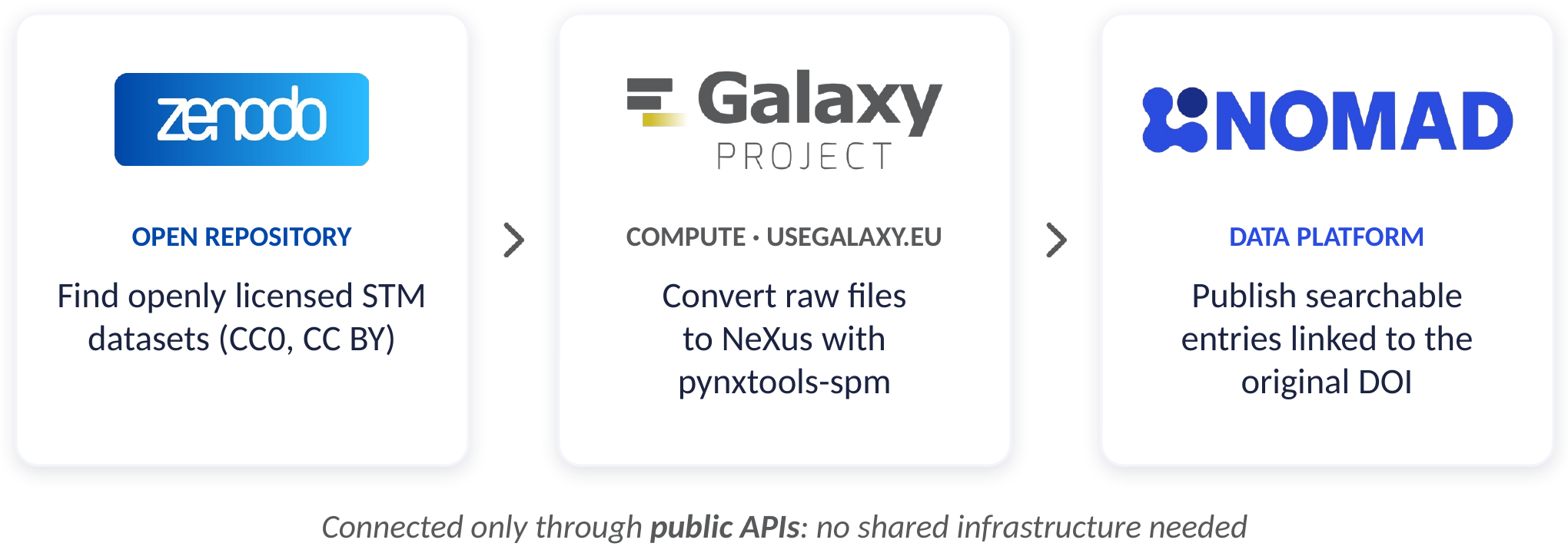
A weekly workflow was developed to automatically retrieve new, openly available scanning tunneling microscopy (STM) datasets from Zenodo, convert them into the standardized NeXus format using Galaxy, and then publish them in NOMAD. In NOMAD, the structured datasets can be more easily found, compared, and reused, while remaining linked to their original sources.
Two ways to run it
This weekly pipeline from Zenodo to NOMAD via Galaxy can be orchestrated in two ways, with either platform leading the workflow.
Example 2:
From harmonized data to analysis
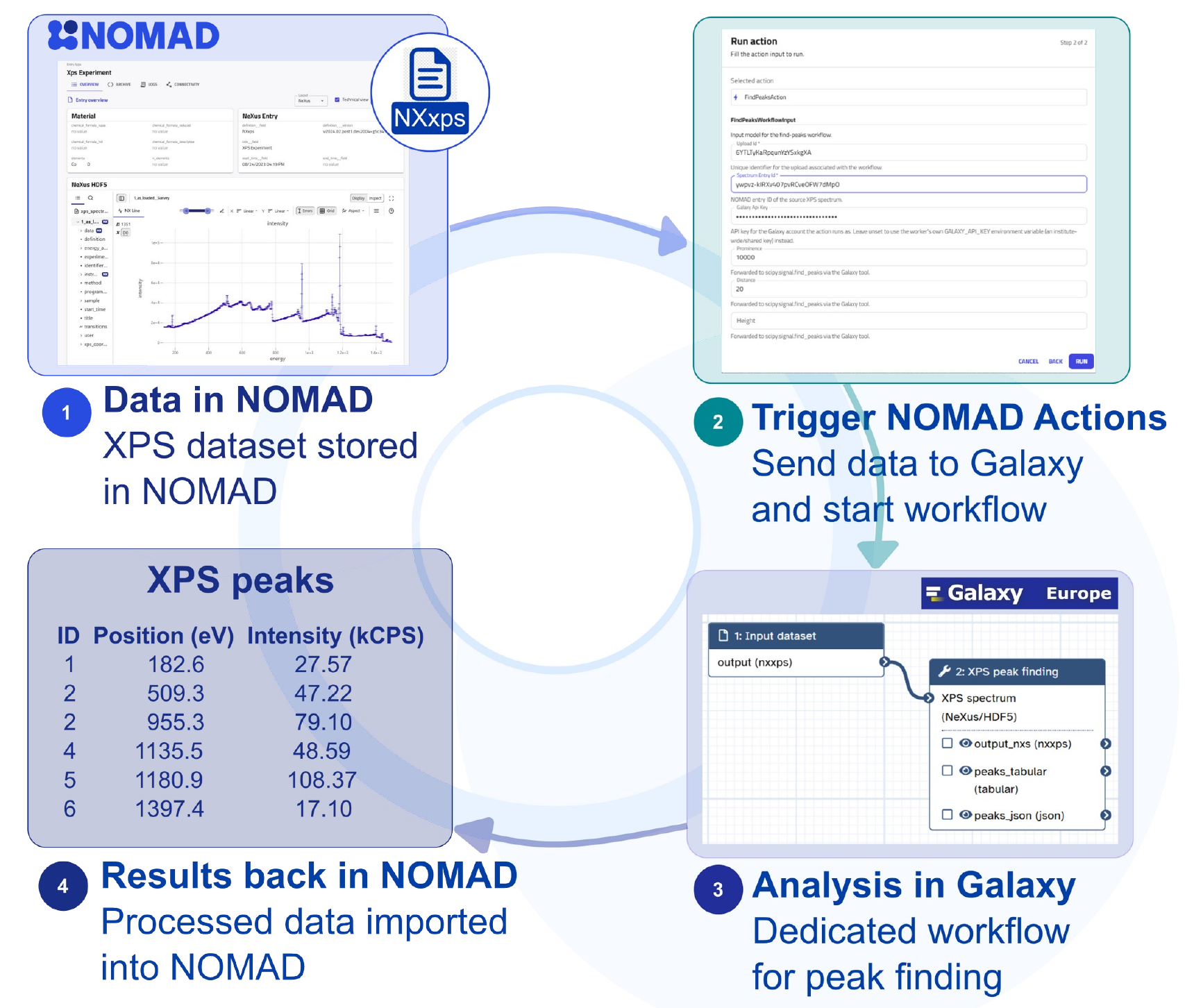
In this demonstrator, a NOMAD Action (a reusable, executable workflow integrated into NOMAD) was developed to connect X-ray photoelectron spectroscopy (XPS) data with analysis tools in Galaxy. A researcher can launch the Action directly from the NOMAD interface after providing a few required inputs. The Action automatically transfers the data to Galaxy, runs a workflow to identify peaks in the spectrum, and returns the results to the original NOMAD upload for reprocessing and further exploration.
NOMAD-led
The weekly run is started by your institute’s own NOMAD installation (NOMAD Oasis), which also publishes the results.
Best for: groups that run, or plan to run, their own NOMAD Oasis and want to keep credentials and control in-house. A small Oasis is enough, as Galaxy does the heavy computing.
Galaxy-led
A small script on any computer starts a ready-made Galaxy workflow, which publishes the results to the central public NOMAD.
Best for: labs without a NOMAD Oasis, existing Galaxy users and anyone who wants to start quickly with minimal infrastructure. All you need is a Galaxy account and a NOMAD account.
Design principles
Ongoing
The pipeline runs weekly and never processes a file twice.
Provenance built in
Every entry links back to its Zenodo DOI.
Licence-aware
Only CC0 and CC BY data is used, always with attribution.
Secure by design
Platform-specific API credentials are used to authenticate access to the respective services.
About NOMAD
NOMAD is a free, open-source infrastructure for scientific data, rooted in materials science and built for customization.
It helps researchers manage, structure, explore, share, and publish research data, supporting the FAIR principles: findable, accessible, interoperable, and reusable.
NOMAD is developed by the NFDI consortium FAIRmat and will be connected to EOSC Node Germany.
What researchers can do with NOMAD:
Upload and manage data
Data can be uploaded step by step, worked on privately and published later as a coherent dataset. NOMAD reads more than 60 data formats and extracts structured data and metadata from the files, so results from different software and experiments become comparable.
Structure and document data
NOMAD automatically processes data from supported simulation codes and experimental instruments into structured, machine-readable formats. Customizable electronic lab notebooks (ELNs) help researchers document experiments and workflows directly within the platform.
Find and reuse data
Researchers can search datasets by scientific properties, methods, and other detailed metadata. Interactive visualizations help them explore, assess, and reuse relevant research data.
Analyze data and connect workflows
NOMAD supports data analysis through integrated tools, Jupyter notebooks, and APIs. Related entries and datasets can be linked through scientific workflows, with interactive provenance graphs allowing researchers to visualize and navigate the connections between data, processes, and results.
Automate experiments and capture data
NOMAD CAMELS is an open-source tool for controlling laboratory instruments and automating measurements through a graphical interface, while recording experimental data with rich metadata. CAMELS can connect directly to NOMAD Oasis, enabling measurement data to be automatically transferred, structured, and made available for searching, exploration, and reuse.
Share, publish, and cite data
Researchers can manage data privately, collaborate with their groups, and publish datasets when ready. Published datasets can be assigned persistent DOIs, making them citable and available for reuse.
The NOMAD software ecosystem
FAIRmat operates the central NOMAD platform, providing free, publicly accessible tools for managing, exploring, sharing, and publishing research data. NOMAD Oasis allows research groups and institutions to deploy the same open-source software on their own infrastructure, retaining control over data storage, access rights, and customized workflows.
Contact for NOMAD

Prof. Dr. Heiko B. Weber
