
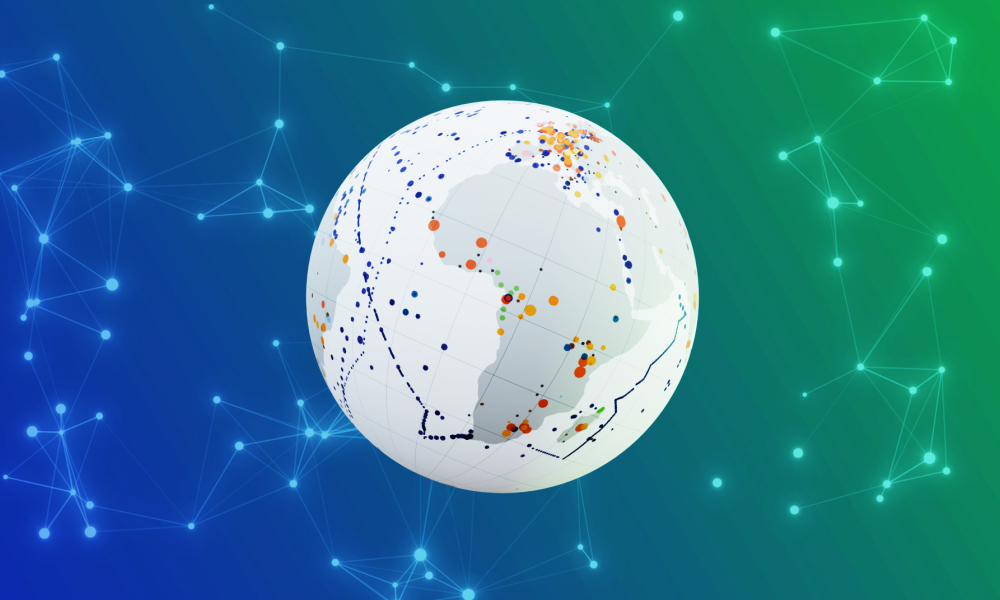
NFDI4Microbiota advances FAIR data in microbiology by promoting community standards and by curating and integrating previously fragmented data resources. Two key efforts, metaTraits and Metalog, have FAIRified data on microbial phenotypic traits and metagenomic contextual metadata. Together with our partner EMBL’s database SPIRE, which provides uniformly processed metagenomes, these vast and interoperable resources enabled a study spearheaded by EMBL that achieved the first truly planetary-scale tracking of gene flow and antimicrobial resistance, recently published in the Journal Cell.
The study shows that microbiomes around the world are more interconnected than previously thought. A small group of highly adaptable microbes, called generalists, can thrive in very different environments, from the ocean to the human gut. Humans accelerate the dispersal of these microbes by creating new connections between environments that would otherwise remain separate. As they move between habitats, generalists can exchange genes with other microbes through horizontal gene transfer. This exchange can also spread genes conferring antimicrobial resistance (AMR), highlighting the relevance of the One Health concept.
The study highlights how NFDI4Microbiota’s data infrastructure makes high-impact, global microbiome research possible. By enabling the integration and analysis of massive datasets across ecosystems, FAIR data infrastructures allow researchers to uncover how microbial communities connect human, animal, and environmental health across the planet.
Publikation:
metaTraits:
Metalog:
Other posts
Posts
Enabling DMP services for the agrosystems research community: DMP4NFDI in FAIRagro
FAIRagro DMP Service Strengthens Research Data Management in Agricultural Systems Research
In collaboration with DMP4NFDI, FAIRagro has established a comprehensive service for data management plans (DMPs) tailored to agricultural systems research. Built on the open-source Research Data Management Organiser (RDMO), the service provides a discipline-specific DMP template with detailed guidance, predefined answer options, and direct access to the FAIRagro Helpdesk. It helps researchers meet funder requirements, promotes good research practice, and improves the findability, accessibility, and reusability of research data in line with the FAIR principles. Developed through a series of joint incubator projects with DMP4NFDI, the service continues to evolve, including the future integration of controlled vocabularies in collaboration with TS4NFDI.
Humanities@NFDI: Working Together for Sustainable Research Data
Cross-Disciplinary Collaboration for Preserving Cultural Heritage
Humanities@NFDI brings together four NFDI consortia to ensure the long-term accessibility and reuse of research data in the humanities and cultural sciences. Through shared standards, vocabularies, and community-driven activities, the initiative fosters interdisciplinary collaboration and strengthens digital cultural heritage research.
QualidataNet by KonsortSWD-NFDI4Society is the “central point of entry” for qualitative data and its secondary use.
QualidataNet – Making Qualitative Research Data Visible and Reusable
QualidataNet is the central access point for the reuse, archiving, and research data management of qualitative research data. Its search portal improves the visibility and discoverability of qualitative datasets from different providers. Through practical guidance, tools such as the open-source anonymization tool QualiAnon, and contributions to international metadata standards, QualidataNet supports researchers, educators, and institutions working with qualitative data. At the same time, the network fosters collaboration, exchange, and a stronger culture of qualitative data reuse across the community.

Recent Comments