Galaxy
Galaxy is a user-facing platform for data analysis and reproducible workflows. The Galaxy–EOSC use case demonstrates how Galaxy can be connected to federated EOSC resources and services, allowing researchers to use distributed data, compute and authentication capabilities through a familiar research environment.
How Galaxy and EOSC work together
Federated access
EOSC AAI can be integrated into Galaxy, allowing users to authenticate through the EOSC Federation. This connects the Galaxy user experience with the federated identity and access infrastructure.
Federated compute
Galaxy can run on resources provided through the EOSC EU Node. The use case demonstrates deploying Galaxy-related services on EOSC resources and connecting them to Galaxy through Pulsar, enabling Galaxy to make use of distributed compute resources.
Bring Your Own Data
Galaxy can connect to external data repositories instead of requiring all data to be uploaded. The use case demonstrates the connection of the EOSC EU Node ownCloud and other repositories, including EUDAT, OpenData, OMERO and Copernicus services
Workflows and tools
The EOSC EU Node Tools Hub and Workflow services can expose Galaxy capabilities, while the European Galaxy Server provides access to reusable Galaxy workflows. This creates a bridge between EOSC service discovery and the Galaxy workflow ecosystem.
Provenance and reproducibilty
Galaxy histories record the data, tools, parameters and steps used in an analysis. This provides an important basis for transparency and reproducibility, while longer-term preservation of data and research objects can be provided by dedicated EOSC services.
In this use case, Galaxy acts as the central platform for analysis, workflows and reproducibility, and connects the building blocks that researchers need for data-driven science.
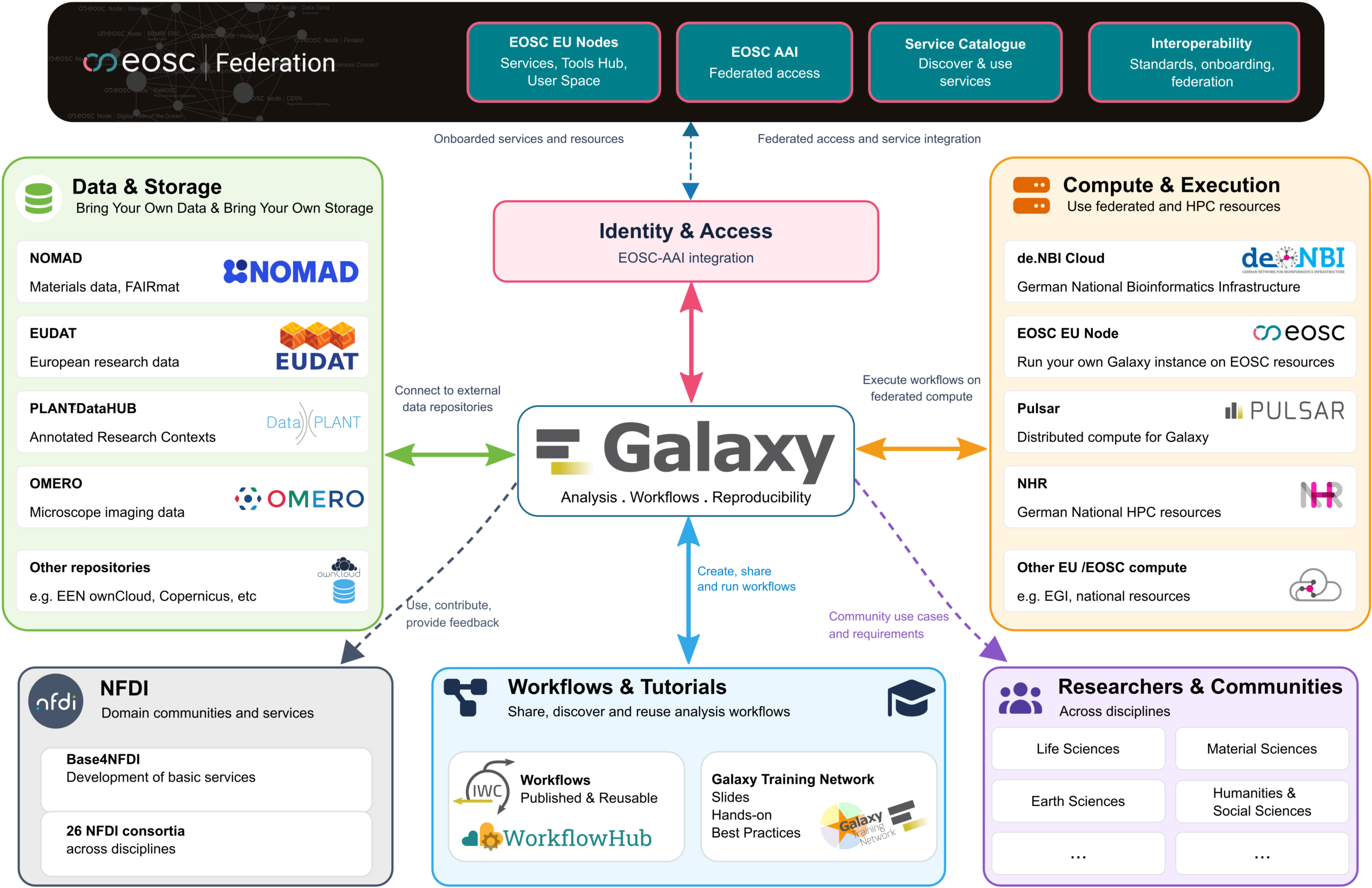
Galaxy connects identity, data, compute and workflows within the EOSC Federation.
See it in action:
This video follows researchers from diverse fields such as microscopy, marine science and astrophysics, all tackling the shared challenge of making sense of complex image data.
The use case showcases the Voronoi Segmentation workflow on the Open Access Galaxy platform, where users, regardless of their coding skills, can import data from European repositories and run automated image analysis to segment, classify, and count objects while retaining a full record of each step.
By making advanced tools accessible and reusable, this example shows how the EOSC Federation helps turn fragmented efforts into coordinated, collaborative science at scale.
Contact information
Galaxy Europe, contact[at]usegalaxy.eu
