A doctoral researcher collects insect observation data over many years; a colleague carefully maps the habitats of rare plant species. Both generate valuable insights into species and ecosystems – yet the impact of their work remains limited to their own projects if the data they collect are not organised in a way that allows others to find and reuse them.
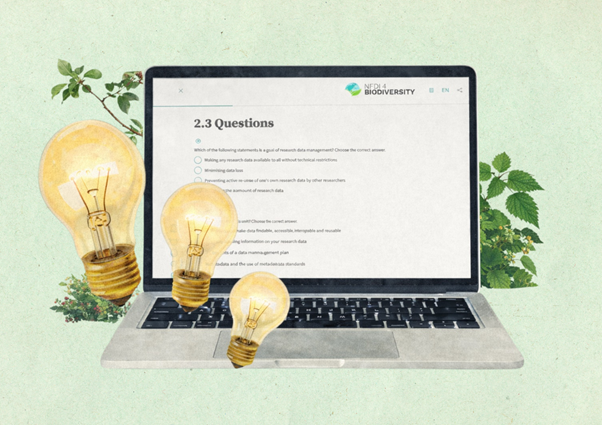
To support researchers in this process, the NFDI4Biodiversity training team has developed an openly accessible self-learning unit. Its key advantage: researchers can complete the online course at their own pace and easily integrate it into their daily work. Step by step, participants are introduced to the fundamentals of research data management (RDM) – from planning and transparent documentation to publishing their data in suitable repositories.
The response has been remarkable: the ILIAS course alone was accessed more than 2,000 times in 2025. In addition, the text version of the course has been read over 1,100 times and downloaded more than 600 times. As an Open Educational Resource, the module is intentionally designed so that other institutions can adopt and further develop it – for example through exportable versions for learning platforms such as ILIAS or Moodle. In this way, the format not only strengthens researchers’ RDM skills directly, but also creates a shared foundation for training the next generation of scientists.
The self-learning unit was developed as part of the NFDI4Biodiversity training programme by the Philipps University Marburg and the German Federation for Biological Data (GFBio e.V.), with support from the Bavarian Natural History Collections (SNSB) and the Center for Interdisciplinary Data and Simulation Science (CIDAS) at the University of Göttingen. In terms of content, the module focuses on discipline-specific aspects of RDM in biodiversity research, while referring learners to existing training resources provided by the Hessian Research Data Infrastructures (HeFDI) for more general topics.
Other posts
Posts
Enabling DMP services for the agrosystems research community: DMP4NFDI in FAIRagro
FAIRagro DMP Service Strengthens Research Data Management in Agricultural Systems Research
In collaboration with DMP4NFDI, FAIRagro has established a comprehensive service for data management plans (DMPs) tailored to agricultural systems research. Built on the open-source Research Data Management Organiser (RDMO), the service provides a discipline-specific DMP template with detailed guidance, predefined answer options, and direct access to the FAIRagro Helpdesk. It helps researchers meet funder requirements, promotes good research practice, and improves the findability, accessibility, and reusability of research data in line with the FAIR principles. Developed through a series of joint incubator projects with DMP4NFDI, the service continues to evolve, including the future integration of controlled vocabularies in collaboration with TS4NFDI.
Humanities@NFDI: Working Together for Sustainable Research Data
Cross-Disciplinary Collaboration for Preserving Cultural Heritage
Humanities@NFDI brings together four NFDI consortia to ensure the long-term accessibility and reuse of research data in the humanities and cultural sciences. Through shared standards, vocabularies, and community-driven activities, the initiative fosters interdisciplinary collaboration and strengthens digital cultural heritage research.
QualidataNet by KonsortSWD-NFDI4Society is the “central point of entry” for qualitative data and its secondary use.
QualidataNet – Making Qualitative Research Data Visible and Reusable
QualidataNet is the central access point for the reuse, archiving, and research data management of qualitative research data. Its search portal improves the visibility and discoverability of qualitative datasets from different providers. Through practical guidance, tools such as the open-source anonymization tool QualiAnon, and contributions to international metadata standards, QualidataNet supports researchers, educators, and institutions working with qualitative data. At the same time, the network fosters collaboration, exchange, and a stronger culture of qualitative data reuse across the community.

Recent Comments